
Acreage & Equestrian Homes in the NC Triad
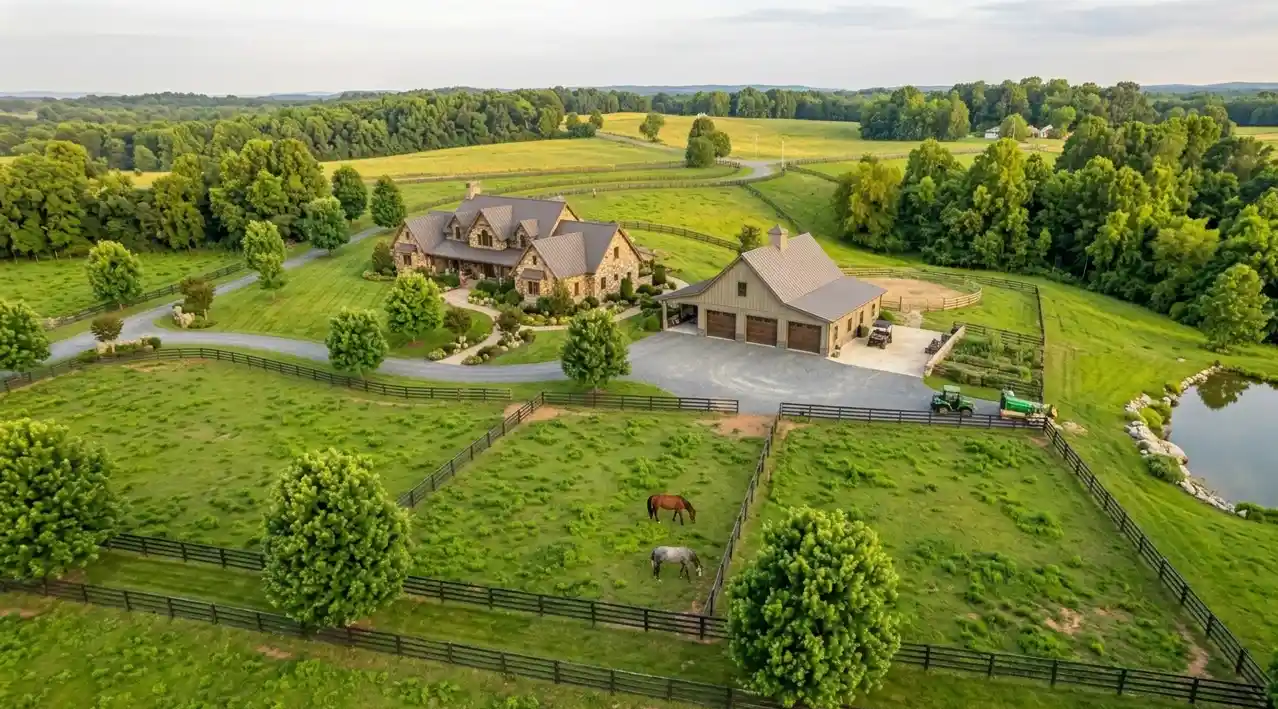
Land. Privacy. Space the suburbs can't offer. The counties surrounding the Triad hold some of the most compelling acreage properties in the North Carolina Piedmont — custom homes on 5, 10, 20+ acres with barns, pastures, ponds, and the kind of setback from the road that changes how you live.
When the Land Is the Primary Asset
In a golf community, the course is the amenity. On the water, the lake is the draw. On acreage, the land itself is the luxury — and evaluating it requires a completely different approach than buying a home in a neighborhood.
Acreage buyers aren't just buying a house. They're buying topography, road frontage, soil quality, water access, fencing, outbuildings, and the distance between their front door and anyone else's. Two 15-acre parcels in the same county can differ by hundreds of thousands of dollars based on what the land actually offers — not just what the house looks like.
Whether you're looking for a working equestrian property, a private estate set back from the road, a gentleman's farm with a pond and outbuildings, or simply a custom home with enough space to breathe — the evaluation starts with the dirt, not the drywall.
Nine Counties, Different Profiles
The Triad's acreage market spreads across nine counties, each with a different character, price structure, and proximity advantage. Some offer land 15 minutes from downtown. Others offer twice the acreage at half the price — with a longer drive. Here's what defines each corridor.
Guilford County
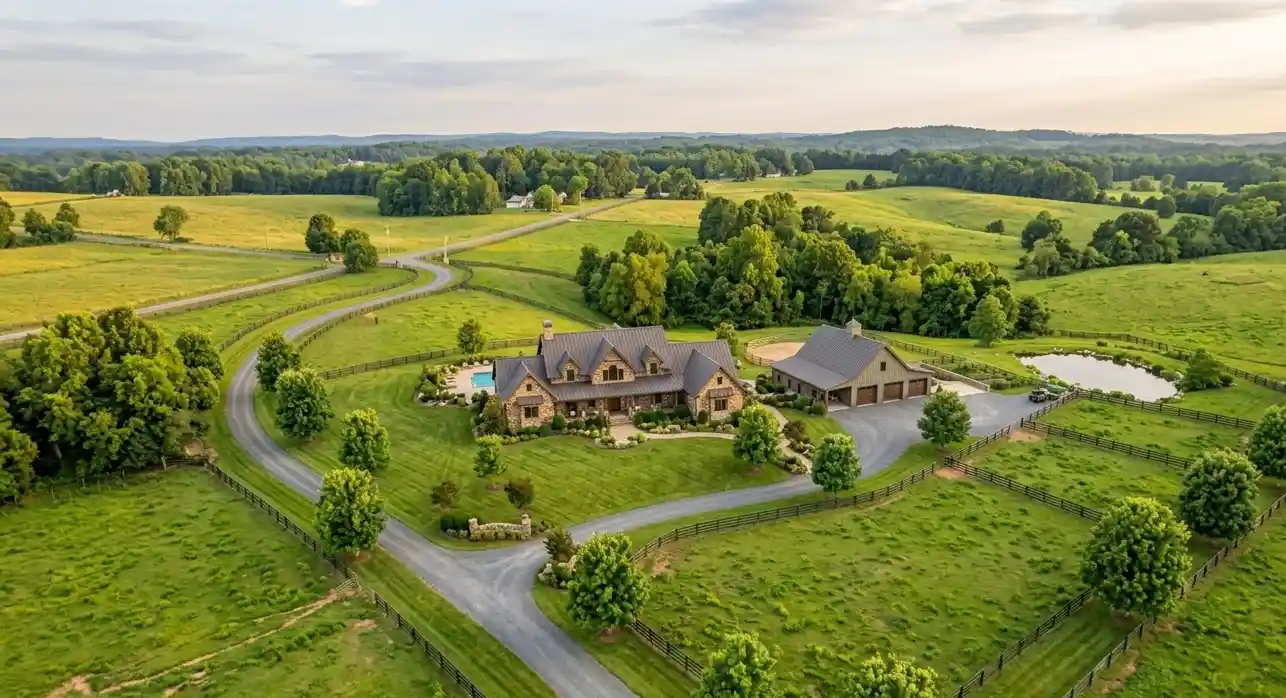
Acreage inside Guilford means proximity to Greensboro and High Point's business corridors — sometimes as close as 15–20 minutes. Parcels are smaller and pricier per acre than outer counties, but the commute advantage is real. Best for buyers who want land without sacrificing access to schools, hospitals, and the Triad's commercial infrastructure.
Forsyth County
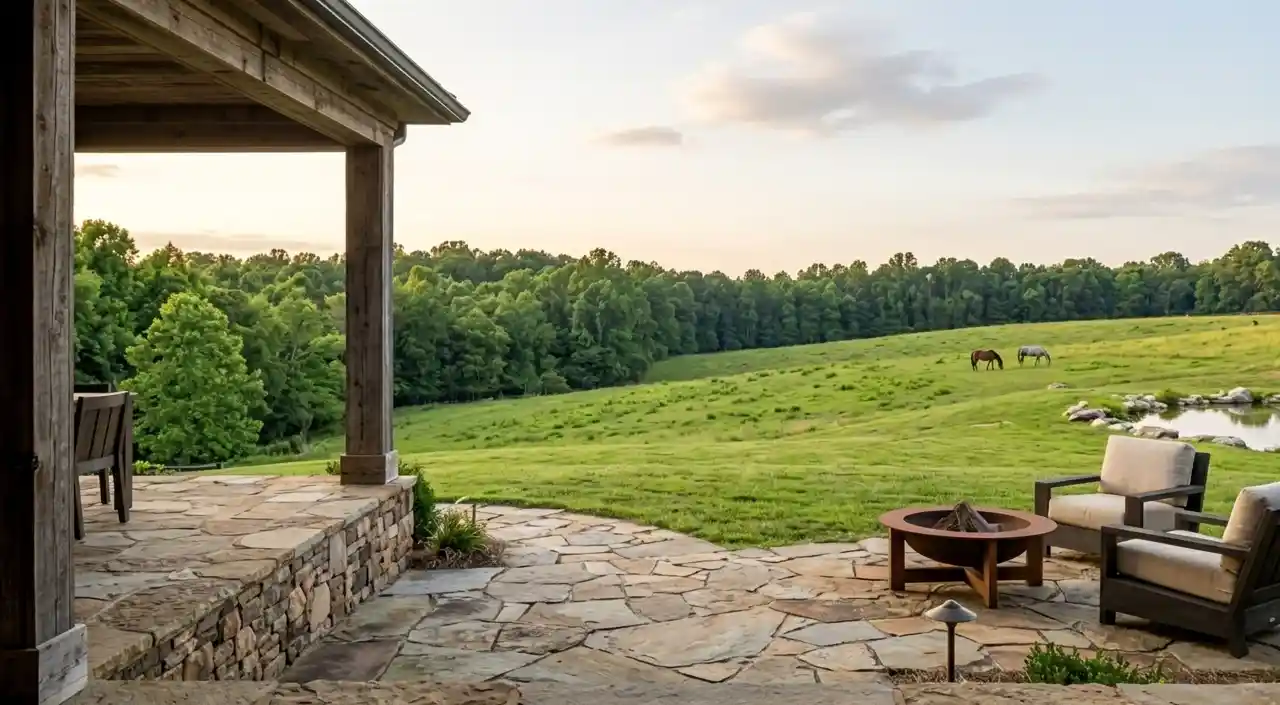
Forsyth's acreage inventory sits along the rural edges north and south of Winston-Salem — far enough for space, close enough for a reasonable commute. The northern corridors toward Belews Creek and the southern stretches toward Clemmons offer the most land. Well-suited for buyers connected to Wake Forest, Atrium Health, or Winston-Salem's business community.
Davidson County
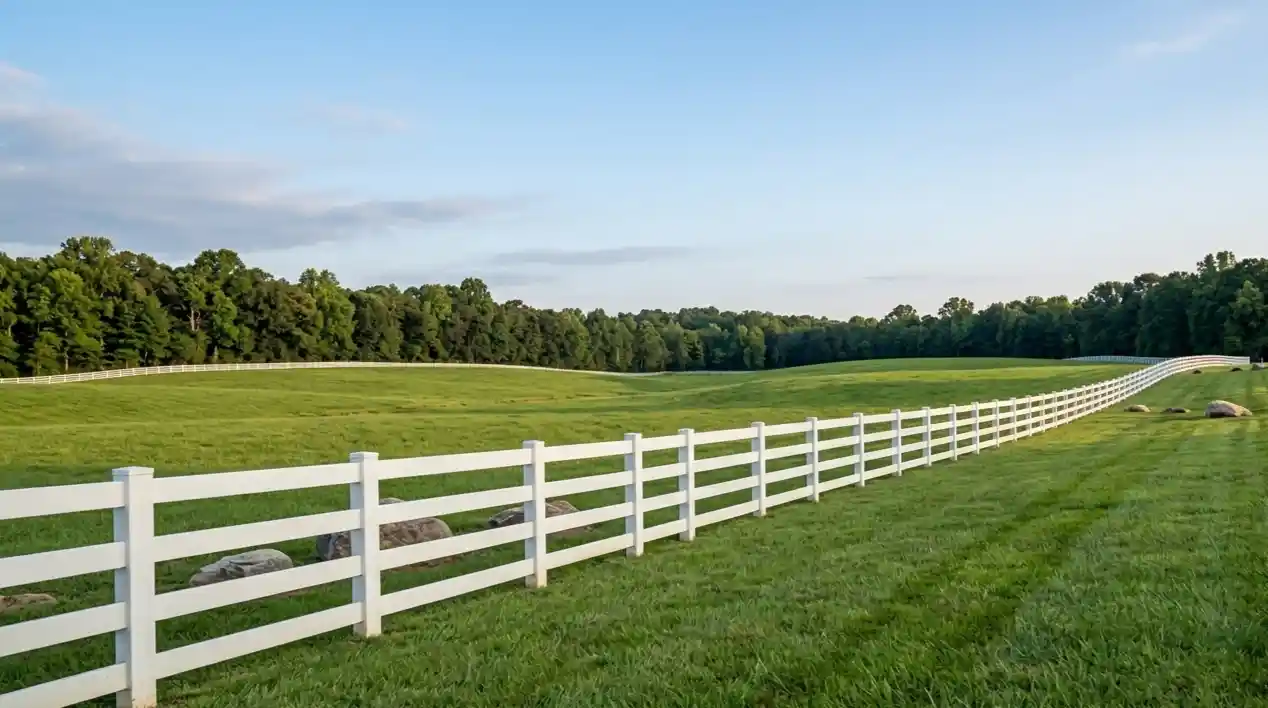
Davidson delivers more acreage per dollar than Guilford or Forsyth — rolling Piedmont terrain, established farming communities, and custom homes on parcels that start at 5 acres and run well beyond. The county also borders High Rock Lake, which adds waterfront-adjacent acreage to the mix. Strong for buyers who want land, outbuildings, and rural feel within 30–40 minutes of the Triad.

Davie County
Davie is where the Triad's acreage market and its golf community market overlap — Bermuda Run sits here alongside genuine rural parcels with barns, pastures, and fenced land. The county has a long agricultural tradition and attracts buyers who want a working-land feel with Winston-Salem access. Some of the best equestrian-ready properties in the region sit in Davie County.
Randolph County
Randolph offers some of the deepest acreage inventory near the Triad — larger parcels, lower per-acre cost, and a genuinely rural character. The Uwharrie National Forest border adds recreational access. Buyers who want 20+ acres, serious privacy, and the ability to build without neighbors in sight tend to end up here. The trade-off is a 30–45 minute commute to Greensboro.
Rockingham County
Rockingham sits north of Greensboro along the Virginia border and offers some of the most affordable land in the greater Triad area. Rolling terrain, tobacco-road character, and parcels large enough for serious agricultural or equestrian use. Price-per-acre here is significantly lower than Guilford or Forsyth — making it a strong play for buyers who prioritize land quantity over commute time.
Alamance County
Alamance sits east of Greensboro along the I-40/I-85 corridor — close enough for a Triad or Triangle commute, rural enough for real acreage. The county offers a mix of established farms, custom estate properties, and newer builds on parcels that benefit from Piedmont topography and proximity to both metro areas. A strong option for buyers who split time between the Triad and the Triangle.
Yadkin County
Yadkin is North Carolina's wine country — and the vineyards, rolling hills, and rural character create a land market with a distinct personality. Acreage here comes with views, privacy, and a pace that feels further from the Triad than the 30–40 minute drive suggests. Buyers who want land with character — not just land with space — gravitate to Yadkin.
Stokes County
Stokes marks where the Piedmont starts climbing into the foothills — and the terrain shows it. Rolling hills, creek-bottom land, Hanging Rock State Park, and the Sauratown Mountains create a setting that feels like mountain living without the mountain drive. Acreage here offers elevation, privacy, and a price structure that rewards buyers willing to go a little further from the city.
What Acreage Buyers Actually Evaluate
Square footage matters less when you're buying land. Here's what experienced acreage buyers — and the ones who should be — are actually looking at before they make an offer.
Land Usability
Not all acreage is equal. Five flat, cleared acres with fencing is more valuable than twenty steep, wooded acres with no access road. What can you actually do with the land? Pasture it? Build outbuildings? Grade a riding ring? Dig a pond? The answer determines the real value — not the parcel size on paper.
Topography & Drainage
The NC Piedmont rolls. That rolling terrain creates microclimates on every parcel — high ground that drains well, low spots that collect water, slopes that limit building, and ridgelines that offer views. Understanding the topography of a specific property is essential before committing to a purchase or a build site.
Well & Septic
Most acreage properties outside city limits run on well water and septic. Both require inspection. Septic capacity, drain field condition, well water quality, and flow rate all affect usability and value. A failed perc test can kill a deal. A strong well with clean water adds real value. Never skip the inspections.
Outbuildings & Improvements
Barns, equipment sheds, workshops, riding arenas, fencing, ponds, and graded access roads — these improvements represent real investment and real value. A property with a well-built barn and board fencing is worth significantly more than raw land with the same acreage. Document what's there and what it would cost to replicate.
Privacy & Road Access
How far is the house from the road? Is there a private driveway? Can you see neighbors? Is the property accessed by a state road, a county road, or a private easement? The arrival experience and the daily privacy level are core to why people buy acreage in the first place — and they vary dramatically from parcel to parcel.
Zoning & Future Use
Agricultural zoning, residential zoning, subdivision potential, conservation easements — the legal framework around the land affects what you can do with it today and what it's worth tomorrow. Some buyers want to subdivide later. Others want the protection of a conservation easement. Know what you're buying before you close.
What Drives Value When You're Buying Land
Standard home valuation tools break down on acreage properties. A Zestimate doesn't know the difference between a flat, fenced pasture and a wooded hillside. Here's what actually moves the number.
Usable vs. Total Acreage
A 30-acre parcel with 10 usable acres isn't worth the same as a 15-acre parcel that's entirely flat and cleared. Buyers and appraisers evaluate land in tiers: cleared and improved, cleared but unimproved, wooded but accessible, and wooded or steep with limited use. Each tier carries a different per-acre value.
Improvement Quality
A custom-built barn with concrete floors, electric, and water represents serious replacement cost. Board fencing at $15–$25 per linear foot adds up fast on a 20-acre perimeter. Ponds, graded roads, riding arenas, equipment shelters — every improvement carries replacement cost value that standard CMAs miss.
Road Frontage & Access
State-maintained road frontage is more valuable than a private easement. A paved private driveway is more valuable than a gravel path. Multiple access points add flexibility and subdivision potential. The way you get to the property — and how the property meets the road — affects value, insurance, and future use.
Proximity Premium
Acreage in Guilford or Forsyth County — 15–20 minutes from a major employer — commands a per-acre premium over similar land in Rockingham or Stokes. The trade-off is parcel size: inner-county acreage tends to be 5–15 acres, while outer-county parcels can run 20–100+. Buyers choose based on how they weight space versus commute.
How Mantle Helps Acreage Buyers
Buying a home on acreage is a fundamentally different process than buying in a neighborhood. The comparable sales pool is tiny. The variables are more complex. And the mistakes are more expensive — because you can't undo a bad well, a failed septic system, or a parcel that doesn't actually support what you planned to do with it.
Mantle starts by understanding what you actually want from the land. Horses? Privacy? Space to build? A gentleman's farm? A future subdivision play? The answer determines which counties, which corridors, and which properties we even consider.
From there, we evaluate beyond the listing sheet — topography, land usability, outbuilding condition, well and septic status, zoning, road access, and the realistic cost of any improvements you'd need to make. We've worked with acreage properties across all nine counties in the greater Triad and understand the differences between them at a parcel level.
Acreage Listings Need Marketing That Shows the Land
The number one mistake in acreage listings: photos show the kitchen, the living room, and the master bath — and the land gets a single wide-angle shot from the back deck. That approach sells the house. It doesn't sell the property.
Mantle's acreage listing strategy is built to sell the full asset:
- Drone photography and video showing the full parcel, boundaries, and outbuildings
- Outbuilding documentation — barn specs, fencing type, riding arena details
- Land-forward marketing copy that leads with acreage, privacy, and lifestyle
- Acreage-specific pricing accounting for per-acre value by tier
- Targeted reach to equestrian, land, and custom-build buyers
Search 5+ Acres by County
Every link below is filtered to show active homes on five or more acres in that county. Click through to browse inventory, see map views, and narrow your search by the corridor that fits your life.
Before You Make an Offer
Acreage buyers benefit from doing more homework upfront, not less. Start with these resources to sharpen your numbers and your strategy.
Buyer Guide
The full Mantle buyer process — search, offer, due diligence, and closing — built for buyers who want to know exactly what's coming next.
READ THE GUIDE →The Real Cost of Buying
Beyond the purchase price: inspections, well and septic testing, surveys, financing fees, and the closing costs that surprise unprepared acreage buyers.
SEE THE NUMBERS →Get Preapproved
Acreage offers move faster when financing is locked. Get preapproved with a lender who understands rural property, well/septic, and land valuation.
START PREAPPROVAL →Acreage & Equestrian Homes — What to Know
Which counties near the Triad have homes on acreage?
Nine counties: Guilford, Forsyth, Davidson, Davie, Randolph, Rockingham, Alamance, Yadkin, and Stokes. Each has a different land profile, price structure, and proximity to Triad business corridors.
What counts as an acreage property?
For the purposes of this page, acreage properties are homes on five or more acres — enough land for privacy, outbuildings, pasture, gardens, or equestrian use.
Are there equestrian properties near the Triad?
Yes. Davidson, Davie, Randolph, Yadkin, and Stokes all have properties with barns, pastures, riding rings, and fenced acreage suitable for horses — some purpose-built, some improvable.
What affects the value of an acreage home?
Land quality, usability, road frontage, topography, water features, outbuildings, fencing, and improvement condition — often more than the house itself. The dirt drives the number.
How far is acreage from Triad city centers?
15 to 45 minutes depending on the county. Guilford and Forsyth offer acreage closest to the core. Outer counties offer more land at lower cost with a longer commute.
What about well and septic systems?
Most acreage properties run on well water and septic. Both require inspection. Septic capacity, drain field condition, well water quality, and flow rate all affect value and usability.
What should acreage sellers know?
Drone photography, outbuilding documentation, land usability mapping, and access detail all matter. Standard listing photos that only show interior rooms miss the primary asset — the land.
Can I subdivide acreage in the Triad area?
Subdivision rules vary by county and zoning. Some parcels can be divided. Others carry agricultural use restrictions or minimum lot sizes. Verify with the county planning department before purchase.
Ready to Find Your Place on the Land?
Whether you're looking for a working equestrian property, a private estate on 20 acres, a gentleman's farm with a pond and a barn, or simply a custom home with room to breathe — a private conversation with Mantle is the best place to start.