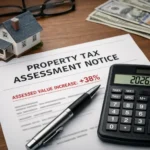

If you were waiting on a new Davidson County tax value in 2026, it never took effect. The county completed its 2026 revaluation, then state law postponed it. Your 2026 tax bill was calculated on the older values, and the new values now arrive in 2027.
For the latest prices and days on market, see our Davidson County housing market report.
Here is where things actually stand, what happened to appeals that were already filed, and how to get ready for the values that land in January.
- Davidson County’s 2026 revaluation has been postponed to 2027.
- The appeal deadline for 2026 values expired April 30, 2026.
- Appeals filed on or before that date are still being reviewed by county appraisal staff.
- Any value changes that come out of those appeals apply to the 2027 tax year.
- If you appealed on time, the county says you do not need to take any additional action.
What Happened to the 2026 Davidson County Revaluation?
Davidson County did the work. Appraisers revalued the county’s parcels and the county adopted a new schedule of values effective January 1, 2026. Notices went out and homeowners appealed.
Then the General Assembly changed the timetable. Senate Bill 889, the Property Tax Reappraisal Moratorium, was ratified on June 10, 2026 and signed into law on June 19, 2026 as Session Law 2026-8.
The law is not specific to Davidson County. It applies to any county that conducted a general reappraisal for 2026 and adopted a new schedule of values effective January 1, 2026 — Davidson was one of them. Guilford County was another, and its 2026 reappraisal was paused by the same law. For those counties the law does three things:
- The 2026 reappraisal cannot be implemented for the tax year beginning July 1, 2026. Counties must instead use the schedule of values from their previous reappraisal. In Davidson County that is the schedule that took effect in 2021.
- The schedule of values that would have become effective January 1, 2026 instead becomes effective January 1, 2027.
- The postponed reappraisal is deemed to have been conducted as of January 1, 2027 for the purpose of the eight-year reappraisal cycle North Carolina requires under G.S. 105-286.
In plain terms: the revaluation was not cancelled and the work was not thrown away. It was delayed by one year.
What Happens If You Already Appealed?
Davidson County’s guidance is straightforward. If you filed an appeal on or before April 30, 2026, the appraisal staff will continue to review it and will contact you about the outcome. The county states that property owners who timely appealed their 2026 property values do not need to take any additional action.
The difference is timing, not outcome. Because the 2026 values do not take effect until January 1, 2027, any adjustment that comes out of your appeal applies to the 2027 tax year rather than 2026.
If your circumstances have changed since you filed, or you are unsure whether your appeal was received, contact the Davidson County Tax Office directly rather than assuming.
Can You Still Appeal Right Now?
Not for the 2026 revaluation. That window closed on April 30, 2026 and the county has stated the deadline has expired.
North Carolina’s appeal structure has not gone away, though. When the 2027 values take effect, the normal path applies: an informal review with the county first, then a formal hearing before the Board of Equalization and Review, and beyond that an appeal to the North Carolina Property Tax Commission.
The county publishes appeal deadlines with each notice. Watch for that notice rather than working from a date you read anywhere, including here.
The Davidson County Property Tax Rate
Your tax bill is not your assessed value. It is the product of two separate numbers:
- Assessed value — what the county says your property is worth. This is what a revaluation changes.
- Tax rate — set annually by elected officials as a rate per $100 of assessed value. This is what the budget process changes.
- Your bill — the two multiplied together, plus any municipal, fire district, or other special district taxes that apply where you live.
Those district taxes are additional to the county rate. Two homes with identical assessed values in different parts of Davidson County can carry different bills for exactly this reason.
Because the 2026 revaluation was postponed, the values underpinning the tax year that began July 1, 2026 are the older ones. County tax rates are adopted by commissioners in June and take effect July 1.
The North Carolina Department of Revenue lists Davidson County’s rate for fiscal year 2026–2027 as $0.54 per $100 of assessed valuation — unchanged from the prior year, which is consistent with the revaluation being postponed rather than implemented.
That is the county rate only. If you live inside Lexington, Thomasville, Denton, Midway, Wallburg or another municipality, a city rate is added on top, and fire district or other special district taxes may apply as well. Two homes with identical assessed values in different parts of Davidson County can carry very different bills for exactly that reason. On a $250,000 assessed value the county-only portion works out to roughly $1,350 a year — $250,000 divided by 100, multiplied by 0.54 — before any municipal or district taxes.
Confirm the current rate at the source before you rely on it. Rates change annually, and figures repeated on real estate sites — including this one — go stale. The Davidson County Tax Assessor and the county budget page are the authoritative places to check, and the NC Department of Revenue publishes county rates by fiscal year.
What Should Homeowners Do Before the 2027 Revaluation?
You have something most homeowners never get: months of warning before new values land. Use them.
Check the county’s record on your property first. Before anyone argues about value, the underlying facts need to be right. Review your record for:
- heated square footage
- lot size or acreage
- bedroom and bathroom counts
- garages, basements, porches, or additions
- outbuildings and other improvements
- quality or condition assumptions
If the basic facts are wrong, the value built on them is likely wrong too. A factual correction is the cleanest argument there is, and it does not require you to debate anybody’s opinion of the market.
Then look at closed sales. Compare your home to recently sold properties similar in size, age, condition and location. Closed sales are evidence. Active listings are asking prices, and automated estimates are guesses.
Document condition now. Photographs of deferred maintenance, dated systems, or damage are far easier to gather today than during a short appeal window. The county works from broad data and may not account for an outdated kitchen, aging HVAC, a difficult floor plan, road noise, or other location drawbacks that affect what a buyer would actually pay.
What helps an appeal
- recent comparable closed sales
- photos of deferred maintenance or damage
- proof the county record is inaccurate
- evidence of location disadvantages
- a recent appraisal when the value difference is substantial
What does not help much
- saying the increase feels unfair
- pointing to insurance replacement value
- using random active listings as proof
- arguing that taxes are already high in general
- waving around automated estimate screenshots like they are sworn testimony
Emotion may be understandable. Evidence wins more often.
Tax Assessed Value vs Market Value
These get used interchangeably and they are not the same thing.
Assessed value is the county’s number, produced by mass appraisal. Appraisers divide the county’s parcels into neighborhoods, analyze sales, and apply a schedule of values across the whole group. It is built for uniformity across tens of thousands of properties, not precision on any one of them.
Market value is what a willing buyer would actually pay today. It reflects your specific condition, updates, layout and location in a way a mass appraisal cannot.
An appraisal is a licensed appraiser’s independent opinion of value for a single property, usually ordered by a lender or for a specific legal purpose. It carries the most weight in a dispute and it costs money.
A CMA — comparative market analysis — is an agent’s analysis of recent comparable sales. It is not an appraisal and carries no official standing, but it is the fastest practical way to find out whether the county’s number is in the right neighborhood before you spend anything.
If the county’s figure looks inflated, an agent’s read on comparable sales is usually the sensible first step. An appraisal makes more sense when the gap is large, the property is unusual, or you want stronger documentation for a formal appeal.
For a sense of how far automated estimates can drift from reality, read can you trust Zillow home values, or get a home valuation as a starting point.
Davidson County Revaluation Timeline
| Event | Date / Status | What It Means |
|---|---|---|
| Last revaluation took effect | 2021 | The schedule of values still in use for the tax year that began July 1, 2026 |
| 2026 revaluation completed; new schedule of values adopted | Effective January 1, 2026 | The county finished the work and issued notices |
| Appeal deadline for 2026 values | April 30, 2026 — passed | No new appeals of the 2026 values are being accepted |
| Senate Bill 889 ratified | June 10, 2026 | Reappraisal moratorium clears the legislature |
| Signed into law as Session Law 2026-8 | June 19, 2026 | Postponement becomes law |
| Tax year begins using the previous schedule of values | July 1, 2026 | Your 2026–27 bill is based on the older values, not the 2026 revaluation |
| 2026 schedule of values takes effect | January 1, 2027 | The postponed values finally apply |
| Reappraisal deemed conducted as of | January 1, 2027 | Sets the clock for the next reappraisal under the state’s eight-year cycle |
Dates published by the county with future notices take precedence over anything summarized here.
Frequently Asked Questions
Why was the Davidson County revaluation postponed?
The General Assembly passed Senate Bill 889, the Property Tax Reappraisal Moratorium, signed into law on June 19, 2026 as Session Law 2026-8. It requires counties that completed a reappraisal effective January 1, 2026 to use their previous schedule of values for the tax year beginning July 1, 2026.
Is the 2026 revaluation cancelled?
No. It is postponed, not cancelled. The schedule of values the county adopted for January 1, 2026 instead takes effect January 1, 2027.
What happens to my 2026 appeal?
Appeals filed on or before April 30, 2026 are still being reviewed by county appraisal staff, who will contact you with the outcome. Any resulting change applies to the 2027 tax year. The county says owners who appealed on time do not need to take additional action.
Can I still appeal my Davidson County property value right now?
Not for the 2026 revaluation — that deadline expired April 30, 2026. When the 2027 values take effect, the normal appeal path reopens, starting with an informal review and then the Board of Equalization and Review.
What is the Davidson County property tax rate?
The NC Department of Revenue lists Davidson County at $0.54 per $100 of assessed valuation for fiscal year 2026-2027, unchanged from the prior year. That is the county rate only – municipal, fire and special district taxes may be additional where you live.
Is tax value the same as market value?
No. Assessed value comes from a mass appraisal built for uniformity across the whole county. Market value is what a buyer would actually pay for your specific home today. They frequently differ.
What should I do before the 2027 revaluation?
Verify the county’s record of your property is factually correct, gather recent comparable closed sales, and photograph any condition issues now. Those three things are the backbone of any successful appeal, and they are far easier to assemble before a deadline than during one.
Want a Real-World Read on Your Home’s Value?
If you want to know whether your Davidson County tax value lines up with what buyers are actually paying, Mantle Realty can review recent comparable sales in your neighborhood and give you a straight answer.
No fluff, no scare tactics. Real numbers and local knowledge. Contact Mantle Realty if you want help reviewing your value, or browse Davidson County real estate.
This article summarizes publicly available Davidson County and North Carolina information as of September 2026. It is not legal or tax advice. Confirm current deadlines, values and rates with the Davidson County Tax Office.