
What Is a Zillow Zestimate and Should You Trust It?
You type your address into Zillow and a number shows up.
That number claims to represent the value of your home.
Many homeowners treat it like fact. Others feel unsure but still use it as a guide.
The problem is simple. A Zestimate is not the full story.
If you are thinking about selling your home or trying to understand what your home is worth, you need to know how this number works and where it falls short.
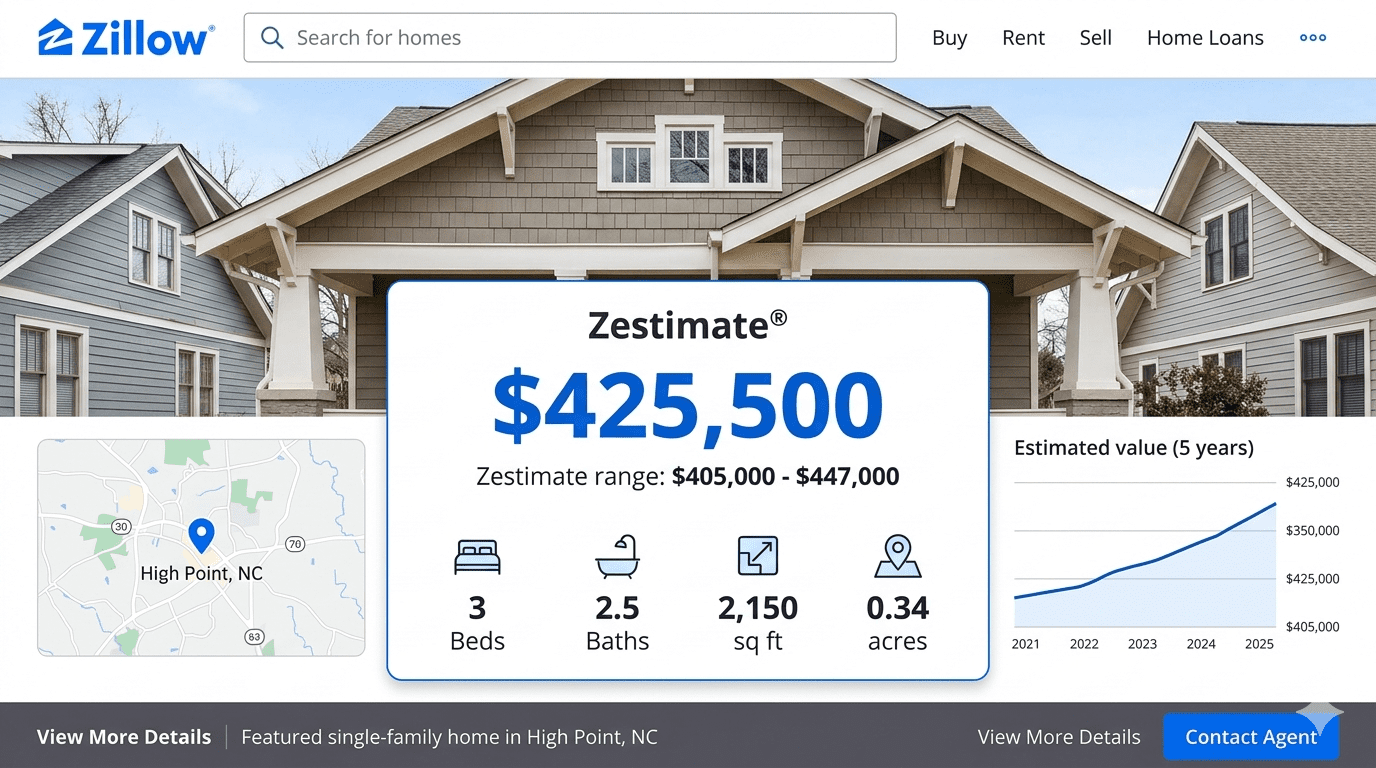
Zillow Zestimate Explained: What Is a Zillow Zestimate?
A Zillow Zestimate is a home value estimate created by an automated system.
Zillow collects data from public records, recent home sales, user-submitted updates, and other data points. It uses that information to calculate what your home is worth.
This system does not visit your property. It does not evaluate condition in person. It does not account for every factor that affects real estate markets.
Zillow defines it clearly. The Zestimate is an estimate, not an appraisal.
That distinction matters more than most people realize.
How Zillow Creates a Home Value Estimate
Zillow builds its estimates using large sets of housing data.
That includes:
- Public records such as tax data and prior sale prices
- Details like number of bedrooms, bathrooms, and square footage
- Comparable properties and nearby home sales
- Actively listed homes in your area
- Market trends across local real estate markets
Each property becomes a data point inside a much larger system.
Zillow then compares homes based on shared characteristics. This includes bedrooms and bathrooms, lot sizes, and general location.
From there, the algorithm generates a value.
That sounds solid on paper.
In practice, there are gaps.
How Accurate Is a Zillow Zestimate?
Zillow publishes its own error rates.
In North Carolina, off-market homes have a median error rate around 7.5%.
This means the Zestimate can be off by thousands of dollars.
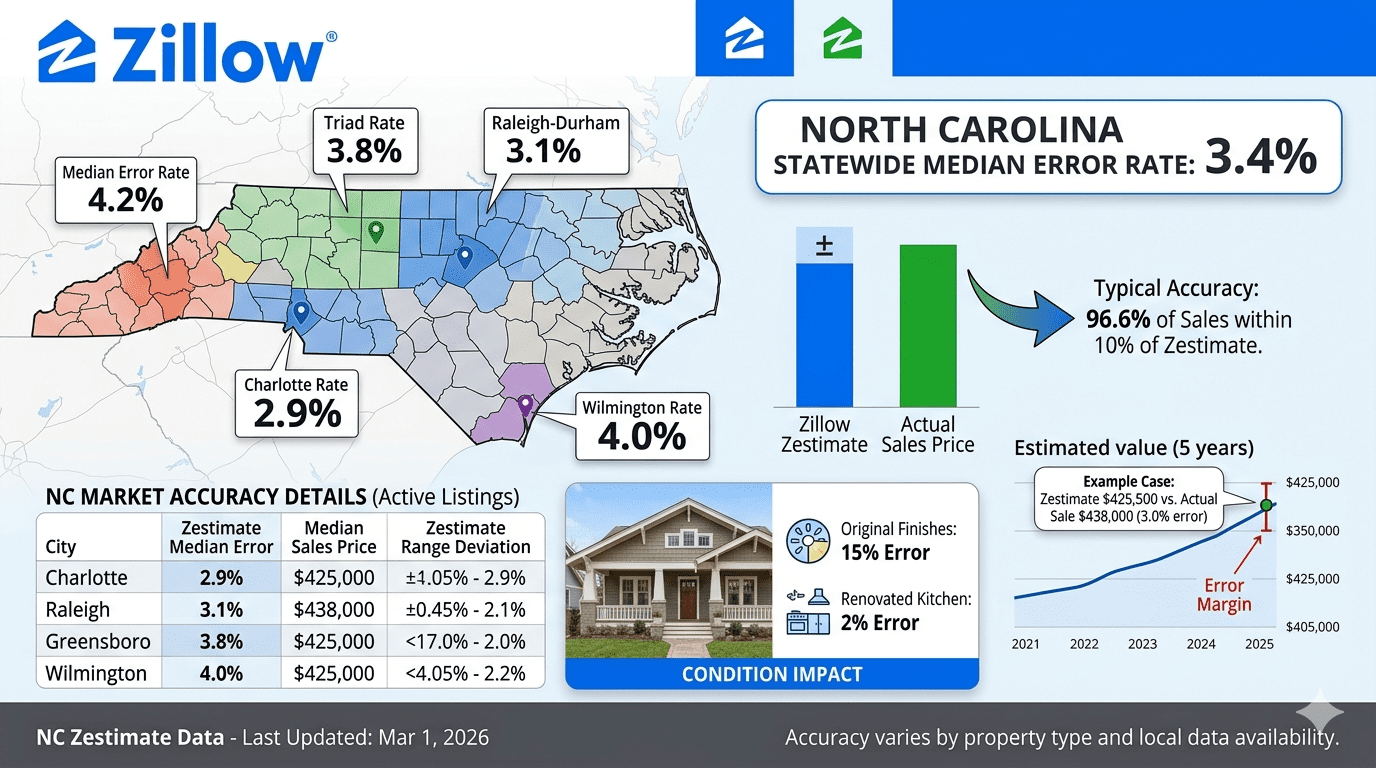
What Error Rates Mean for Your Home
Let’s look at a simple example.
Zillow says your home is worth $225,000.
With a 7.5% margin, your actual value could be closer to $242,000.
That difference is $17,000.
If you base your pricing on the lower number, you risk losing that amount during your home sale.
Many buyers and sellers do not realize how often this happens.
Why Zillow Zestimate Often Misses the Value of Your Home
The Zestimate relies on patterns. Real estate does not always follow clean patterns.
It Does Not See Condition or Updates
Zillow cannot walk through your home.
It does not know if you renovated your kitchen, updated flooring, or replaced your roof.
It also does not know if your home needs repairs.
Condition plays a major role in home sales.
That information rarely shows up in public records.

It Groups Homes That Are Not Truly Comparable
Zillow often compares homes within the same zip code.
That creates problems.
Homes in the same area can have very different values based on:
- School districts
- Neighborhood demand
- Property condition
- Lot sizes
- Location within city limits
Comparable properties need more than shared zip codes. They need true similarity.
It Misses Unique Home Details
Not every feature fits neatly into a database.
Zillow may struggle to account for:
- Custom upgrades
- Land value
- Views or waterfront access
- Detached structures
These factors can shift the value of your home in a major way.
Real Estate Markets Change Quickly
Home values move with supply and demand.
Interest rates, inventory, and buyer activity can shift within weeks.
An automated system may lag behind current market conditions.
This delay affects accuracy.
Why Pricing Your Home Based on Zillow Can Cost You
Using a Zestimate as your list price creates risk.
Pricing Too Low
You list below market value.
You receive strong interest and multiple offers.
The home sells quickly.
That sounds positive, but it often means the home was underpriced.
You leave money on the table.
Pricing Too High
You list above market value based on an inflated estimate.
Buyers pass on the home.
Days on market increase.
Price reductions follow.
This pattern can lower your final sale price.
Both situations come from relying on a number without deeper insight.
Comparative Market Analysis CMA vs Zillow Zestimate
A comparative market analysis CMA gives a clearer picture of your home’s value.
Real estate professionals build a CMA using:
- Recent comparable sales
- Pending and actively listed homes
- Detailed home comparisons
- Local market behavior
This process focuses on comparable properties that match your home in size, condition, and location.
A CMA reflects how buyers respond to real listings.
That is different from an automated estimate.
You can learn more about pricing strategies and home sales on our Mantle Realty blog.
Professional Appraiser vs Zillow Estimate
A professional appraiser evaluates your home in person.
They review:
- Home details and layout
- Condition and upgrades
- Comparable sales
- Local market trends
This process produces a detailed report used by lenders.
A Zestimate cannot replace that level of evaluation.
When a Zillow Zestimate Can Be Useful
The Zestimate still has value when used correctly.
You can use it to:
- Get a general home value estimate
- Compare homes at a high level
- Track broad market trends
You should not rely on it for pricing decisions or financial planning.
How to Get the Real Value of Your Home
If you plan to sell your home, accurate pricing matters.
Start with local expertise.
A real estate professional can evaluate your property, review comparable sales, and explain how your home fits within current real estate markets.
This approach gives you a pricing strategy based on real data and real buyer behavior.
If you want to understand what your home is worth today, you can contact Mantle Realty for a personalized home value estimate.
Final Thoughts on Zillow Zestimate Accuracy
Zillow provides a number.
That number comes from data, not experience.
It does not see your home. It does not understand your neighborhood at a detailed level. It does not negotiate with buyers.
It serves as a starting point.
If you rely on it alone, you risk mispricing your home and affecting your final sale.
Use the Zestimate as a reference.
Then confirm the value of your home with real estate professionals who understand your local market.
The difference between an estimate and the right price can be thousands of dollars.